




 Ufi Aluga Hilika ma Hatini: He a te Kehekehega ma ko fea e Tatau ke Fakatau?
Ko te hilika ko he filo fakanatura; ko te hatini ko he lalaga e masani lava o polyester. E molemole atu uma lāua i te koton. Ko nei...
Faitau te fakatonuga
Ufi Aluga Hilika ma Hatini: He a te Kehekehega ma ko fea e Tatau ke Fakatau?
Ko te hilika ko he filo fakanatura; ko te hatini ko he lalaga e masani lava o polyester. E molemole atu uma lāua i te koton. Ko nei...
Faitau te fakatonuga
Flax™ Linen Flat Sheet — White
Flax™ Linen Flat Sheet — White
Moe mālūlū ma mamago i te linen hinahina malū.
Tau masani $99.90
Tau masani $199.90 Tau fakaitiitia $99.90 Fakaitiiti 50%
E fakatatau te tau o te ave i te taimi e totogi ai.
Stops night sweatsNo clammy clingSofter every washWarm, not stark
Aofaki
Ave Fua I Aho e 4–7
- Fakataitaiga e Hē Lamatia mo Aho e 30
- Totogi Malu
Couldn't load pickup availability
Sleeping under this linen flat sheet white feels different from the first night. The slubby weave leaves thick and thin threads in place, so the fabric sits off your skin in a thousand small ridges instead of lying flat — and because it is stonewashed before it ships, it arrives soft and only grows softer with every wash.
- 100% stonewashed French flax linen
- Soft warm white, bright but never stark
- No optical brighteners in the cloth
- Plain double-turned hem, no elastic or corners
- Four bed sizes available
Layer it over your duvet or under it, and let the sheet wear in beautifully.
Fakamatalaga o te koloa
100% stonewashed French flax linen in soft white
Mea na fai ai
150×230 · 180×220 · 220×240 · 240×260 cm
Lahi
Fakamatalaga puupuu
Fakamatalaga puupuu
Tauhiga
Tauhiga
Mea na Faia Ai
Mea na Faia Ai
Fakamatalaga fakapitoa
Fakamatalaga fakapitoa
- Mea na fai ai
- 100% stonewashed French flax linen, soft white
- Lahi
- 150×230 · 180×220 · 220×240 · 240×260 cm
Te Ave ma te Taunuku
Te Ave ma te Taunuku
E fua te ave mo nā oka uma. E masani lava ona taunuku i te 4–7 aho mai te aho na oka ai. E maua e koe he hootaga e hukehuke ai i te imeli i te taimi e ave ai tau oka.
Fakafoki
Fakafoki
E 30 aho mai te aho na taunuku ai tau oka e faitaitai ai i lalo o te faitaitaiga 30 aho e hao mai lamatiaga. Ko te totogi o te toe lafo ki tua e ko koe e tauaveina, vagana kafai e he lelei te mea. Kafai e taunuku atu he mea kua malepe, e he lelei, pe e he tutuha ma te fakamatalaga, imeli mai he ata ona ka hui pe toe fakafoki atu ai te tupe.
Ni fehili?
Ni fehili?
Imeli ki support@calmeden.com. E tali atu matou i loto o itula faigaluega e 12, Aho Gafua ki Aho Falaile, 9am–5pm ET.
E fiafia koe ke talanoa? Telefoni ki +1 (775) 205-9950.


Hollow flax and moving air
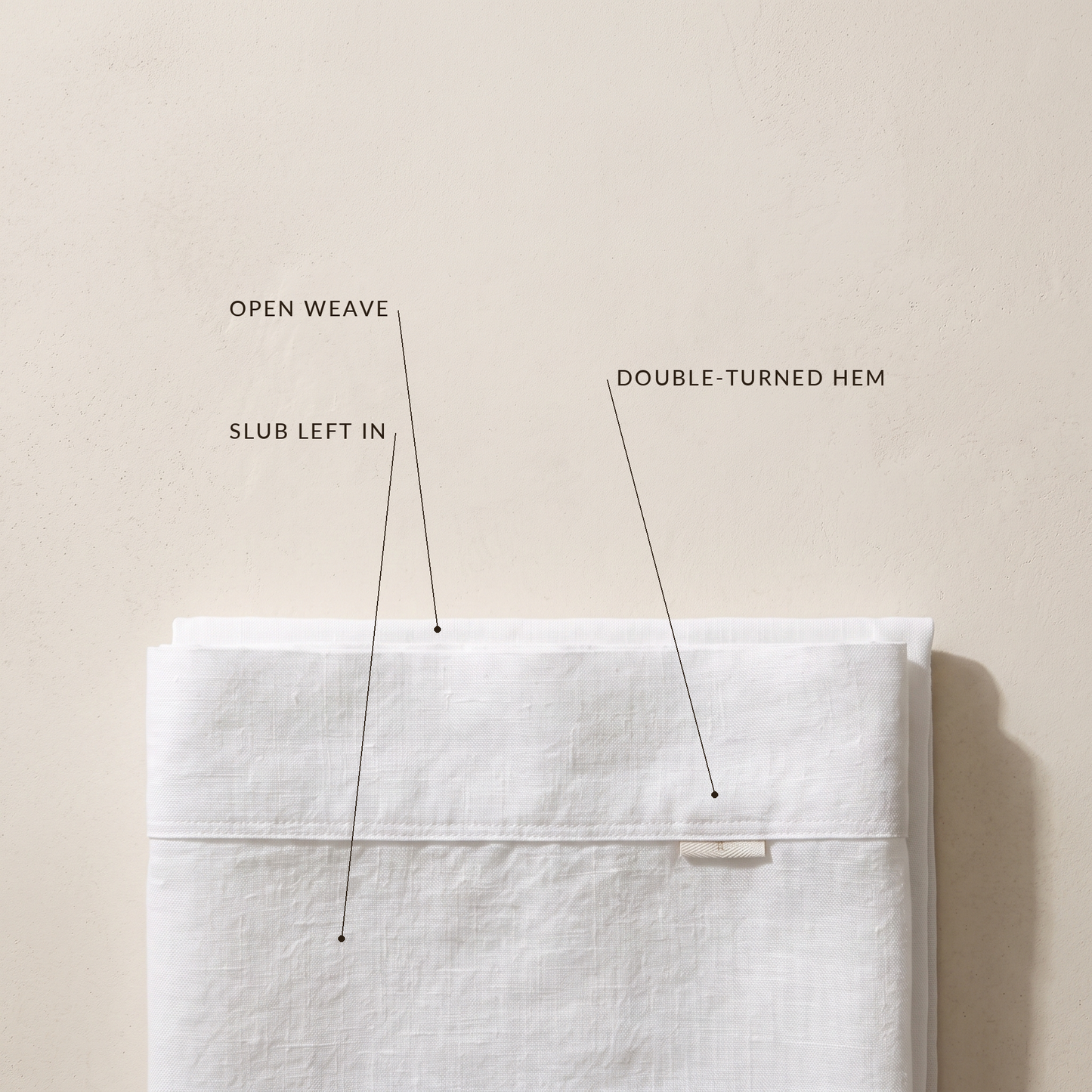
The slubs are left in the yarn and not combed out, so the surface is thousands of tiny ridges and the sheet touches your skin at points and not across a flat plane, with air moving in the gapsFlax fibre is hollow: it wicks about a fifth of its own weight in moisture and gives it up quickly, so sweat is drawn off the skin and evaporatesIt is stonewashed before shipping, so the season of laundering that breaks in new flax is already done. It arrives soft and goes on softening, where cotton pills and thins
100% French flaxStonewashed finishDouble-turned hem

A white that stays quiet

Still dry at three in the morning

Look closely at the weave
4.7 / 5 ★★★★★
E falalaua e tagata e tāua ki ei te mālōlōga
Mai i nā pō toe malōlō ki te moe o aho uma, e filifilia e o mātou tagata fakatau nā mea e mau lelei.
★★★★★
Wanted white without the hotel blue
Every white sheet I'd bought before had that faint blue tinge that looks cold against a wooden bed. This doesn't — it's a warm white, and next to my oatmeal duvet it looks intentional rather than clinical. Got the king. Bonus I wasn't expecting: I've stopped waking up damp around 3am, which I'd blamed on the room for two years.
Tagata fakatau kua fakamaonia
★★★★★
Size up, and don't fight the creases
Two things for anyone ordering. These are sheet measurements not mattress measurements, so if you like a deep tuck go one size bigger — I took the 220 for a king and it's fine but not generous. And it creases; ironing lasts until the first person sits down. I take it out of the dryer slightly damp and throw it straight on, which looks better than ironing anyway.
Tagata fakatau kua fakamaonia
★★★★★
Softer after four washes than it was new
I've had linen before that went thin and papery within months. This has gone the other way — four washes in and it's noticeably softer with a heavier drape. I skipped the softener like it says and used a liquid detergent. Only practical note: it holds a lot of water, so it took two goes on low in the dryer the first time. Worth knowing if you're doing a same-day change.
Tagata fakatau kua fakamaonia
Fehoahoani i te taimi e manaomia ai e koe
Fehili e Fehili Mahani
Which size does my bed need?
The sizes given are the finished sheet, not the mattress, and confusing the two is the most common ordering mistake. As a guide: 150 × 230 cm suits a single (90 cm), 180 × 220 cm a double (135 cm), 220 × 240 cm a king (150–152 cm) and 240 × 260 cm a super king (180 cm). If your mattress is deeper than about 30 cm, or you like a firm tuck on all four sides, take one size up. Linen relaxes and softens and does not shrink hard, so a larger size only adds drape.
Is the white bright or creamy?
It is a clean white, clearly whiter than our undyed Natural Flax, but a warm white and not a blue-white. It contains no optical brighteners, the additive that makes most white bedding glow slightly blue in daylight and look cold beside wood and plaster. In a warm-toned room it looks bright and crisp, and photographed under cool light it looks softer than a hotel sheet. If you prefer the greige of raw flax, choose the Natural Flax colourway.
Is it scratchy? Linen has put me off before.
What you touched was almost certainly unwashed flax, which really is stiff and needs a season of laundering to break in, and most people give up before that. This sheet has been stonewashed at the mill: tumbled with stone, so the fibres are broken in before it reaches you. It comes out of the bag soft and matte, with a slubby texture you can feel and no scratchiness. It then goes on getting softer, which is unusual, since most fibres are at their best when new and decline from there.
Why is linen cooler than cotton when it feels heavier?
Weight and warmth are different things here, and two mechanisms are at work. The first is structure: the slubs and the open weave hold the fabric away from your skin at thousands of small points, so air keeps circulating and no warm, damp layer forms between you and a flat surface. The second is the fibre: flax is hollow, absorbs around 20% of its own weight in moisture and releases it quickly, so sweat is drawn away and evaporates. Smooth percale and sateen do neither. They lie flat, and once damp they cling.
Will white linen turn grey or yellow with time?
Not if you avoid two things. Chlorine bleach is the main cause: it weakens flax and, against expectation, causes the yellowing it is supposed to prevent. Fabric softener is the other: it leaves a waxy film that builds up, greys the weave and blocks the wicking. Wash at 40°C with the correct dose of a mild liquid detergent, leave room in the drum, and dry on the line in daylight when you can, because sunlight is the gentlest whitener. An oxygen-based whitener, used sparingly, is a safe occasional reset.
What is in the pack? Is it a full set?
One flat sheet and nothing else: no fitted sheet, no pillowcases and no duvet cover. It has a plain double-turned hem on all four sides, with no elastic and no sewn corners, so it works as a top sheet under a duvet or alone as a single cover in summer, which is how many people use it. For a bed that matches from end to end you will need to buy the other pieces separately.
Atonu e fiafia foki koe ki ei
-

 Fakaitiitiga
Ufi Aluga Hilika Mulberry Soie™
Ala ake ma te fiafia o tō paku ma tō lauulu.
Tau masani $69.90Tau masani$99.90Tau fakaitiitia $69.90Fakaitiitiga -

 Fakaitiitiga
Ufi Aluga Fakamālūlū Chill™ (2 i te Pusa)
Tau masani Kamata i te $34.90Tau masani$54.90Tau fakaitiitia Kamata i te $34.90Fakaitiitiga -

 Fakaitiitiga
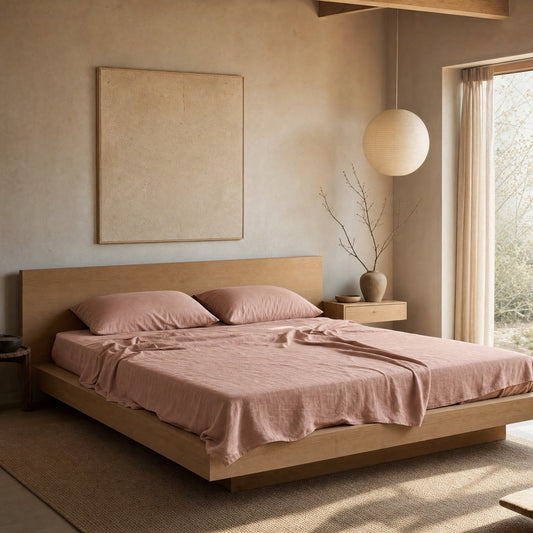
Ie Moega Lineni Flax™ – Piniki Vaivai
100% lineni Falani kua fufulu ki maka mo tagata e vevela i te moe — i te lanu piniki māfanafana
Tau masani Kamata i te $99.90Tau masani$199.90Tau fakaitiitia Kamata i te $99.90Fakaitiitiga -

 Fakaitiitiga
Ie Moega Vavae Fetaui Wren™
Ke hēai lava he toe ala i luga o he moega telefua — o fili pipiki ma te elasitika loloto i nā itu uma e taofi mau ai tulimanu uma
Tau masani Kamata i te $69.90Tau masani$119.90Tau fakaitiitia Kamata i te $69.90Fakaitiitiga
Mai te tuhi talaaga
Te Tuhi o te Moe
Ni fakatonuga aogā mo te filifili ma te tauhi o au mea mo te moe.
-
 Ufi Aluga Hilika ma Hatini: He a te Kehekehega ma ko fea e Tatau ke Fakatau?
Ko te hilika ko he filo fakanatura; ko te hatini ko he lalaga e masani lava o polyester. E molemole atu uma lāua i te koton. Ko nei...
Faitau te fakatonuga
Ufi Aluga Hilika ma Hatini: He a te Kehekehega ma ko fea e Tatau ke Fakatau?
Ko te hilika ko he filo fakanatura; ko te hatini ko he lalaga e masani lava o polyester. E molemole atu uma lāua i te koton. Ko nei...
Faitau te fakatonuga
-
 Te Maualuga Lelei o te Aluga mo Tagata e Momoe i te Itu (Ma Fautuaga mo te Tīga o te Ua ma te Uma)
E manaomia e tagata e momoe i te itu he aluga e maualuga ma malō ke fakatumu ai te avanoa i te vā o te ua ma te...
Faitau te fakatonuga
Te Maualuga Lelei o te Aluga mo Tagata e Momoe i te Itu (Ma Fautuaga mo te Tīga o te Ua ma te Uma)
E manaomia e tagata e momoe i te itu he aluga e maualuga ma malō ke fakatumu ai te avanoa i te vā o te ua ma te...
Faitau te fakatonuga
-
 Aluga Makalili: Ko he a e Fakamakalili Moni ai Koe (ma Mea e Hē)
E makalili nisi aluga mo he minute e tahi kae mafanafana ai; ko nisi e tumau te lelei ona e gāoioi te matagi...
Faitau te fakatonuga
Aluga Makalili: Ko he a e Fakamakalili Moni ai Koe (ma Mea e Hē)
E makalili nisi aluga mo he minute e tahi kae mafanafana ai; ko nisi e tumau te lelei ona e gāoioi te matagi...
Faitau te fakatonuga
-
 Ufi Mata Moe Mamafa, Hilika ma Fakatino: Vē ona Filifili
Ko te ufi mata moe te auala taugofie e hili e pouliuli katoa ai te potu. Ko nei te auala e filifili ai i te mamafa, hilika,...
Faitau te fakatonuga
Ufi Mata Moe Mamafa, Hilika ma Fakatino: Vē ona Filifili
Ko te ufi mata moe te auala taugofie e hili e pouliuli katoa ai te potu. Ko nei te auala e filifili ai i te mamafa, hilika,...
Faitau te fakatonuga


